In 1900, 41% of the US workforce worked on farms. By 2000 it was 1.9%. Nobody in 1900 would have predicted that food would get cheaper, farms would produce far more, and almost everyone who used to farm would do something else. Most people would have called it a catastrophe.
I think the same story is starting again, in knowledge work first, then, much more slowly, in physical work. I also think the people who tell it as an uncomplicated success are skipping the chapters where it went badly. This essay is my attempt to hold both.
What the base rate says
| Measure | Value |
|---|---|
| 1900 | 41% |
| 1930 | 21.5% |
| 2000 | 1.9% |
Source: USDA Economic Research Service, Economic Information Bulletin 3 (1900, 1930 and 2000 values as published).
The USDA’s own history says farm output “has grown dramatically, allowing consumers to spend an increasingly smaller portion of their income on food and freeing a large share of the population to enter nonfarm occupations.” People spend what they save on other things, and new work appears. Autor and coauthors estimate that roughly 60% of the work Americans did in 2018 was in job titles that did not exist in 1940.
That is the optimistic half. The other half is just as well documented. Acemoglu and Restrepo found that each additional industrial robot per thousand workers reduced the employment-to-population ratio by 0.18 to 0.34 percentage points and wages by 0.25 to 0.5 percent in the local labour markets that took them. Average gains and local losses are both real. The trouble is that the average does not live anywhere.
Agents: the tasks move first, the jobs move later
Measured today, the effect of agents on the whole economy is small, and the effect at the bottom of the career ladder is not.
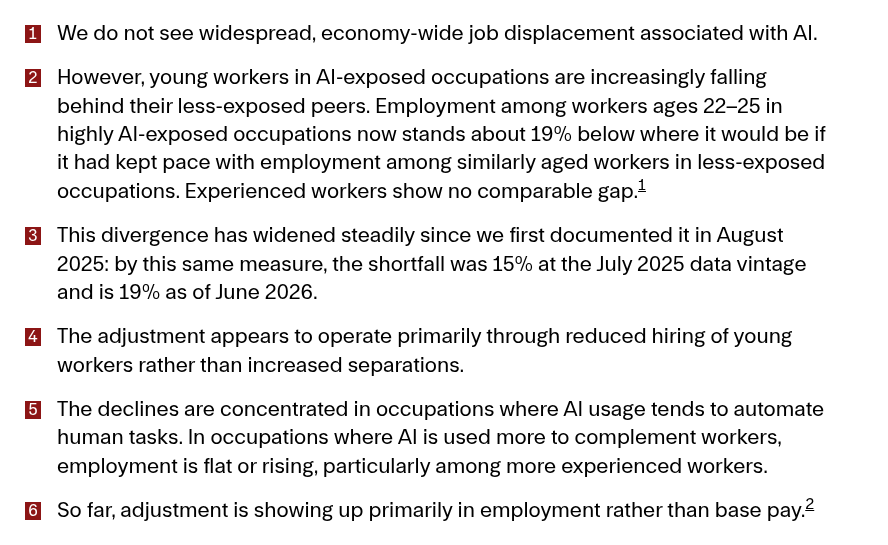
The Stanford Digital Economy Lab’s “canaries” study, revised in August 2026 using payroll data, says: “We do not see widespread, economy-wide job displacement associated with AI.” Then the second half of the finding: employment among workers aged 22 to 25 in highly AI-exposed occupations stands “about 19% below where it would be” if it had kept pace with the same-age workers in less exposed jobs. “Experienced workers show no comparable gap.”
A study that links chatbot adoption surveys to Danish administrative records found “precise null effects on earnings and recorded hours”, ruling out effects larger than 2% two years after ChatGPT launched. What moved was the structure of work: “employers absorb AI through task reorganization”, including new tasks in oversight and integration. Output gains also leak on the way to shipped product. In the code-review post an NBER paper finds autonomous agents raising commits by 240% but releases by 30%, which the authors blame on “human bottlenecks in the production chain.”
So the near-term picture is: tasks get cheap, people shift from doing to specifying and checking, and the first people to feel it are the ones who used to learn by doing the tasks that are now cheap. That last point is the difference that worries me most. The farm and the factory pulled young people into new sectors. The entry-level desk job is where a junior used to get the practice that made them a senior.
Robots: decades behind agents, and unevenly
Software moves at the speed of a download. Hardware does not.
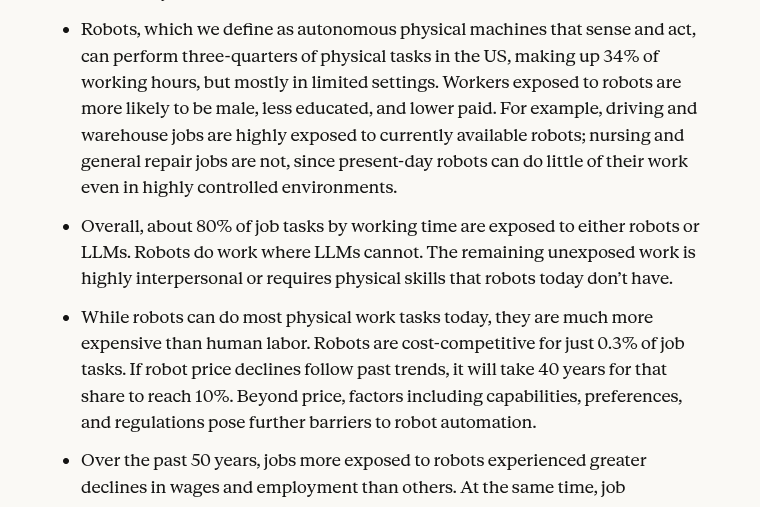
Anthropic’s robot exposure index, published on 30 September, finds that robots can already perform 74% of physical tasks in the US, making up 34% of working hours. Yet “robots are cost-competitive for just 0.3% of job tasks. If robot price declines follow past trends, it will take 40 years for that share to reach 10%.”
| Measure | Value |
|---|---|
| Robots can technically do | 74% |
| Cost-competitive with a human | 0.3% |
Source: Anthropic, 'What work can robots do?' (30 September 2026). A vendor-run index; the cost-competitive figure depends on its price assumptions.
Farming shows both sides. The labour shortage is real: 398,258 H-2A guest-worker positions were certified in fiscal 2025, up 185% in ten years, according to the American Farm Bureau Federation. The hardest part, picking delicate fruit, is still slow. A June 2026 paper on a dual-arm apple-picking robot reports an 80.0% per-attempt success rate and a 7.53-second cycle per arm, and its authors write that “low throughput and poor performance in orchard environments hinder its commercial adoption.”
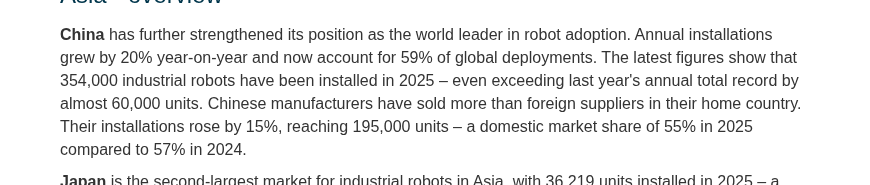
Manufacturing is further along, and it has shifted geography. The International Federation of Robotics reports a record 5 million industrial robots in operation, with more than 600,000 installed in 2025. China alone installed 354,000, which is 59% of the global total.
Humanoid robots are the part with the most hype. Counterpoint Research counts more than 22,000 shipped in the first half of 2026, nearly 300% more than a year earlier. But entertainment and research units still made up “above 60%” of shipments, with manufacturing at 13% and logistics at 5%.
Our take: good on average, if three things hold
I think this goes well for the economy overall, for the same reason it did before. When a task gets cheap, the thing it produces gets cheaper, demand moves elsewhere, and people are freed for work that machines cannot yet do. Human effort moves from the “how” to the “what”: deciding, specifying, reviewing, and caring for things. Anthropic’s study of about 400,000 Claude Code sessions finds that “in a typical session, people make most of the planning decisions (what to do) and Claude makes most of the execution decisions (how to do it).” The authors work for a company that sells the tool, so read that as a description, not a verdict.
But I do not think “it worked before” is an argument. Three differences decide it.
- Speed. US farm employment fell from 41% to 21.5% over three decades, about 0.65 percentage points a year (calculated). METR’s measurements put the doubling time of the task length agents can complete at 88.6 days since 2024 and 130.8 days since 2023, on a benchmark that its authors caution is unreliable above 16 hours. A transition that gave a generation to adjust may give a few years.
- Who goes first. The bottom rung. If the junior roles disappear, the supply of seniors dries up a decade later. Firms that keep hiring and training juniors on harder, supervised work will have the senior engineers and analysts that others cannot buy.
- Where the gains go. The robots evidence is a warning here: the workers who lost most were local and concentrated, and the gains were diffuse. Supports aimed at the loss work better than supports aimed at the average. An NBER study of wage insurance for displaced workers, which tops up pay when someone takes a lower-paid job, found the programme “self-financing even under conservative assumptions.” I found less evidence for help with entry-level hiring, which is part of why I think it needs trying and measuring.
What would change my mind: unemployment in exposed occupations that rises and stays up for more than two years, a wage gap in those jobs of more than 2%, and a 22 to 25 year-old gap that keeps widening without those workers re-entering through new kinds of work. None of those is happening yet. All of them are measurable.
For anyone choosing what to learn or hire for, the practical advice is plain. Get good at the “what”: the question worth asking, the definition worth fixing, the result worth doubting. The work an agent does still needs someone who can tell when it is wrong.
References
- The 20th century transformation of US agriculture and farm policy USDA Economic Research Service, EIB-3.
- New frontiers: the origins and content of new work, 1940-2018 Autor, Chin, Salomons and Seegmiller, NBER.
- Robots and jobs: evidence from US labor markets Acemoglu and Restrepo, NBER, March 2017.
- No widespread displacement, but the AI employment gap for young workers has widened to 19% Stanford Digital Economy Lab, August 2026.
- Still waters, rapid currents (working paper w33777) Humlum and Vestergaard, NBER, revised March 2026.
- Writing code vs. shipping code: productivity effects across generations of AI coding tools NBER, revised September 2026.
- Agentic coding and persistent returns to expertise Anthropic, 16 June 2026.
- Time Horizon 1.1 METR, 29 January 2026.
- Wage insurance and displaced workers (working paper w32464) NBER, May 2024.
- What work can robots do? Anthropic, 30 September 2026.
- H-2A program use continues to soar American Farm Bureau Federation, 22 January 2026.
- A modular dual-arm apple harvesting robot with enhanced field performance arXiv, June 2026.
- Five million robots now operate in factories globally International Federation of Robotics, 24 September 2026.
- Global humanoid robot shipments soar nearly 300% YoY in H1 2026 Counterpoint Research, 20 August 2026.